PRACTICAL BUYER GUIDE
How to compare dry and wet dog food on a dry-matter basis
Remove the effect of moisture before comparing guaranteed protein or fat, and understand why the result remains an estimate rather than a quality score.
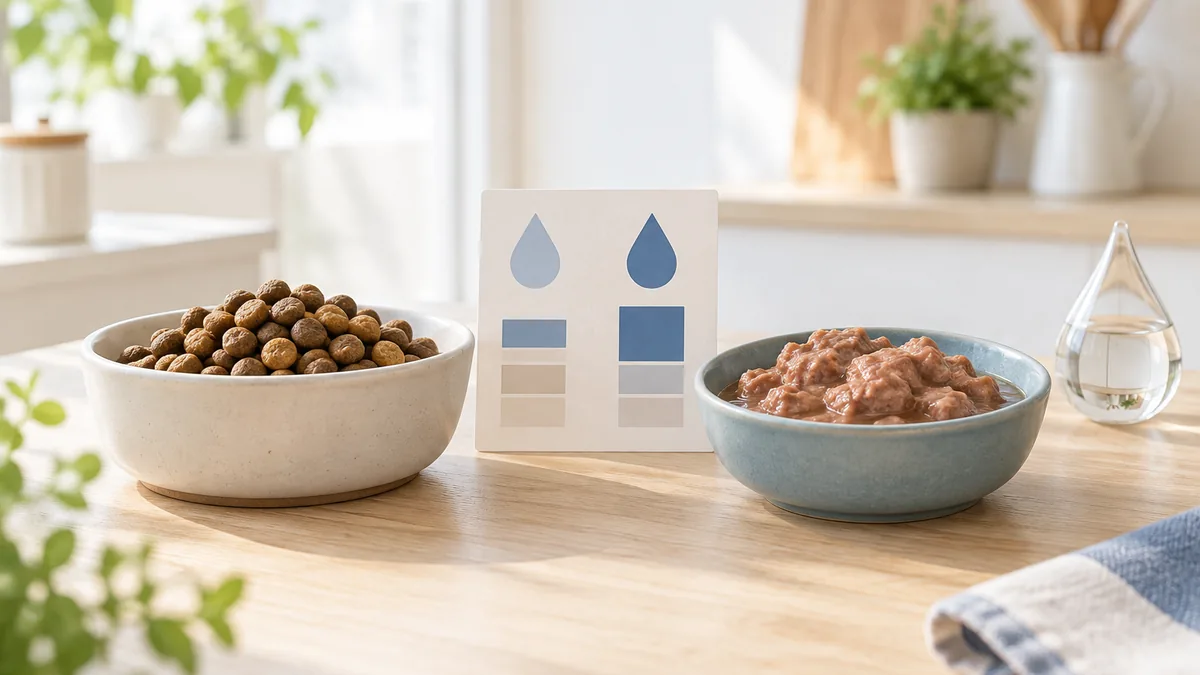
The percentages on the package include water
A guaranteed analysis is normally presented on an as-fed basis: the water in the product is part of the total weight. This makes the printed percentages useful for comparing products with similar moisture, but potentially misleading when a dry kibble is placed beside a can or pouch.
Protein and fat are commonly guaranteed as minimums, while fibre, ash and moisture are commonly maximums. A protein guarantee of 22% does not state that every batch contains exactly 22%, and it should not be relabelled as an average laboratory result.
Use a two-step conversion
First calculate dry matter: 100 minus the stated moisture percentage. Then divide the nutrient percentage by the dry-matter percentage and multiply by 100. For an illustrative dry food with 22% minimum protein and 10% maximum moisture, the calculation is 22 ÷ 90 × 100, or about 24.4% protein on a dry-matter basis.
For an illustrative wet food with 8% minimum protein and 78% maximum moisture, the calculation is 8 ÷ 22 × 100, or about 36.4%. The apparent 22-to-8 advantage reverses after moisture is removed. These figures are examples, not data for a real product.
Do not overstate the precision
Combining a minimum nutrient guarantee with a maximum moisture guarantee produces a useful label-based estimate. It does not reproduce the product’s actual average analysis. If actual moisture is below the stated maximum, the result changes. Small calculated differences should therefore not be presented as a certain ranking.
If a manufacturer publishes typical or average analysis, record that value separately from the guarantee and retain its definition and source date. Comparing numbers with different definitions to decimal places creates false precision.
Dry matter is one comparison, not a verdict
Dry-matter conversion helps compare nutrient concentration. It does not measure ingredient quality, amino-acid balance, digestibility, manufacturing control, or suitability for an individual dog. A larger protein or fat percentage is not automatically better.
Also check feeding purpose, life stage, calories, feeding directions and the manufacturer’s current information. A dog with a medical condition or prescribed diet needs nutrition targets from the veterinary team rather than a general online comparison.
References
The calculation and interpretation were checked against the U.S. FDA page “Complete and Balanced Pet Food,” the Pet Food Association of Japan’s explanation of guaranteed analysis, and the WSAVA Global Nutrition Toolkit.